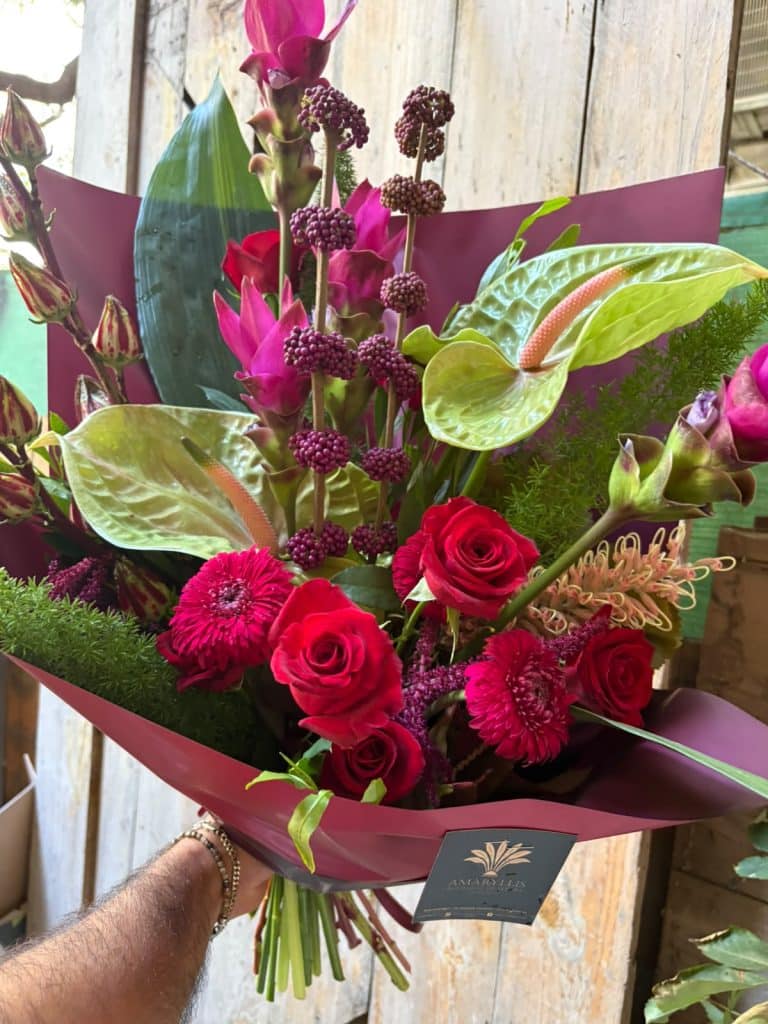
Israeli flowers vs. imported flowers – how a professional florist chooses the flowers for a bouquet
By Asaf Levi | Founder and floral designer of Amaryllis Tel Aviv | Over 20 years of experience in floral design and arranging
When you look at a finished bouquet, you see colours, shapes and composition. But for a florist, the work starts much earlier — with choosing the materials.
One of the questions we come across is whether imported flowers are considered higher quality or more luxurious than flowers grown in Israel. The answer, in my experience, is much more interesting than “yes” or “no”.
After more than 20 years of working with flowers every day, I have learned that quality isn’t determined by the country a flower came from. It is determined by the variety, the season, the grower, the stage of cutting, the freshness, the journey the flower has made and above all — its condition at the moment the florist chooses to work with it.
Sometimes the Israeli flower is the best choice. Sometimes an imported variety offers a design possibility that can’t be had in Israel at that moment.
A good florist shouldn’t choose by label. They should choose by the flower in front of them.
What is the difference between Israeli flowers and imported flowers?
Israel is a country with a rich agricultural tradition and a developed flower industry. Throughout the year we work with a wide variety of flowers from local growers, alongside flowers and varieties that come from abroad.
Imported flowers can add special varieties, unusual shades, particular sizes or flowers that aren’t available in Israel at that time.
But the word “imported” on its own is no promise of quality.
A local flower cut at the right time, well cared for and delivered to us in excellent condition can be of higher quality and more impressive than an expensive flower that has travelled a long way.
So for me the question isn’t where the flower came from, but which flower is the right choice today.
How does a florist assess the quality of a flower?
When I choose flowers for Amaryllis, I look at much more than their colour.
I examine the stem, the foliage, the strength of the flower, the stage of opening, the quality of the petals and how the flower is expected to develop over the coming days.
This matters because flowers are a living material.
Some flowers look almost closed when chosen and will open gradually at home. Others are already at their peak. Sometimes a slightly less open flower is the right professional choice for delivery, because we want the customer to enjoy the blooming process rather than receive a flower that has already passed its best moment.
Why does the season matter more than the flower’s passport?
One of the most important things in floristry is working with the season, not against it.
Peonies are an excellent example. When they arrive at the right time and in high quality, their beauty is hard to beat. But there is no reason to build every bouquet around a peony just because it is a sought-after flower.
The same is true of ranunculus, tulips, hydrangeas, special rose varieties and other seasonal flowers.
When a flower is at the height of its season, it can give a bouquet quality, movement and character that are hard to achieve when you try to force a material that isn’t at its best.
So at Amaryllis we prefer to ask: what is most beautiful and best right now?
When do imported flowers actually give an advantage?
There are cases where imports open up new possibilities for the floral designer.
These can be special rose varieties, shades that are hard to find on the local market, flowers with an unusual structure or materials that particularly suit the composition we want to create.
In a luxury bouquet, for example, one imported flower with a special presence can sometimes change the whole composition.
But in my view, luxury isn’t created by all the flowers in the bouquet having come from abroad.
Luxury is created by the choice.
Sometimes the most beautiful combination is between an excellent seasonal Israeli flower and a special variety from abroad.
Why isn’t it always worth insisting on a particular flower?
A customer may call and ask for a flower they saw in a photo. That’s completely natural.
But if that flower isn’t in the quality we want that day, I prefer to suggest a better alternative rather than use it just to tick a box.
The question I try to understand is: what did you love about the flower?
The colour?
The softness?
The size?
The shape?
Its romantic or sculptural feel?
Once you understand that, you can sometimes find another material that gives exactly the feeling you were looking for — and in better quality.
That is one of the differences between choosing flowers from a list and working with a florist.
Is a more expensive flower necessarily a better flower?
No.
The price of a flower is affected by many factors: season, availability, variety, size, import, demand and the costs of growing and transport.
So a high price isn’t the only measure of quality.
Nor does a luxury bouquet have to be a collection of the most expensive flowers in the shop that day.
Sometimes a relatively simple flower, when it is exactly in the right season and combined in a good composition, gives a bouquet much more character than an expensive flower chosen only because of its price.
How does the choice affect the design?
The materials determine much of the bouquet’s language.
Some flowers give volume.
Others create line and movement.
Some flowers bring softness.
Some create a focal point.
And some materials are there solely to give a little air between the other elements.
So I don’t look at each flower separately.
I think about the relationships between them.
Good floristry is largely editing: knowing what to put into a bouquet, but also knowing when to stop.
Local flowers, imports and the identity of the bouquet
For me, a bouquet doesn’t need to prove where its materials came from.
It needs to feel right.
If there are wonderful local flowers that day, I want to use them. If a particular imported variety gives the bouquet something we don’t currently have on the local market, it has a place too.
After more than two decades of working with flowers, I believe one of a florist’s important roles is to make this choice for the customer.
Not to choose the flower with the most impressive name — but the flower that is at its right moment.
Frequently Asked Questions
Are imported flowers higher quality than Israeli flowers?
Not necessarily. A flower’s quality depends on the variety, the season, freshness, care and its condition at the time of choosing. There are local flowers of exceptional quality alongside special imported varieties.
Why are imported flowers used?
Imports sometimes make it possible to work with varieties, colours, sizes or types of flowers that aren’t available in Israel at that time.
Should you choose a bouquet by the types of flowers in it?
You can mention flowers you love, but it’s worth leaving the florist a little freedom to choose the best materials available that day.
Why is a flower in the photo sometimes replaced?
Flowers are a seasonal, living product. If a certain flower isn’t available or isn’t of sufficient quality, it is sometimes better to choose an alternative that suits the bouquet’s style and colours.
Is a bouquet with imported flowers necessarily more luxurious?
No. Luxury in flowers comes from the quality of the materials, the choice of colours, the proportions, the composition and the handwork — not just from where the flowers come from.
In the end, the florist chooses the flower’s right moment
When working with a living material, there is no fixed formula.
The same flower can be wonderful this week and less interesting a month from now. A variety that wasn’t available yesterday can arrive tomorrow and change the direction of a whole bouquet.
That is one of the reasons I still love working with flowers so much after more than 20 years.
Every day the materials are slightly different.
And when a customer tells me: “I trust you, choose whatever is most beautiful today”, they are in fact letting me do the most important part of my work as a floral designer.
Choosing.
Asaf Levi
Founder and floral designer of Amaryllis
81 Ben Yehuda St., Tel Aviv