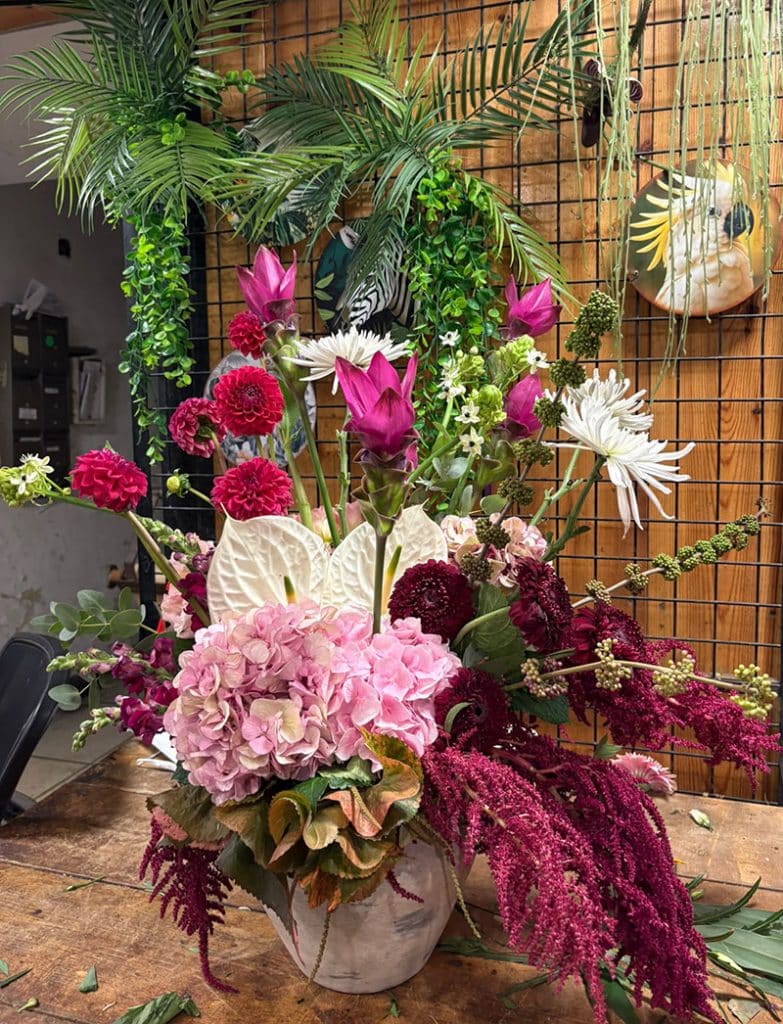
Why a Bouquet Does Not Have to Look Exactly Like the Website Photo – and What Really Matters When Ordering
By Asaf Levi | Founder and floral designer of Amaryllis Tel Aviv | Over 20 years of experience in floral design and arranging
One of the most natural questions when ordering a bouquet online is: will the bouquet I receive look exactly like the one in the photo?
My answer is: not always — and sometimes it’s actually better that way.
Flowers are a living raw material. They change with the season, the weather, the grower, the variety, the stage of opening and which flowers are in the best quality that day. Even two roses of the same variety are not completely identical.
So in my view, a photo of a bouquet on the website should clearly define the style, colours, character and level of the bouquet — but professional work with flowers sometimes also requires judgement.
The goal isn’t to copy a photo at any cost. The goal is for the customer to receive a beautiful, quality, precise bouquet at the level they ordered.
Should the bouquet you order be exactly identical to the photo on the website?
When the materials are available in good quality, you can of course get very close to the bouquet in the photo.
But flowers have variables that don’t exist in an industrial product.
If you order a shirt of a certain model, you expect to receive exactly the same shirt. Flowers work differently. They grow in nature and in greenhouses, reach the market at different stages and change throughout the year.
So there may be slight differences in shade, flower size, degree of opening and sometimes even in a particular type of flower.
For me, the important question isn’t just “is every stem identical to the photo?”, but “have the character, colours, style, quality and value of the bouquet been kept?”
Why do you sometimes need to replace a flower that appears in the photo?
There are several reasons.
A certain flower may be out of season. It may be available on the market but in a quality I’m not happy with. Sometimes it arrives smaller than usual, too open or in a condition where I know it won’t develop well at home.
In that situation the florist has two options:
use the flower only because it appears in the photo, or choose another material that will do a better job in the bouquet.
I prefer the second option.
In my view, fidelity to the photo shouldn’t come at the expense of the quality of the bouquet.
Does replacing a flower reduce the value of the bouquet?
It shouldn’t.
A professional substitution isn’t taking out a significant flower and replacing it with an inferior one just to save money.
When I replace a material, I look at the role it played in the bouquet: its colour, volume, height, shape, texture and presence within the composition.
The goal is to find a flower that fills a similar role and keeps the level of the bouquet.
If a significant substitution is needed that changes the character of the order, I think it should be treated differently rather than simply making an arbitrary change.
What happens if a certain flower is out of season?
This is one of the main reasons why it isn’t right to promise that every bouquet will be an exact copy of a photo all year round.
Peonies are a good example. When they are in season and in good quality, they can be a wonderful material. At another time they may be hard to get, very expensive or simply not in the quality I would want to put in a bouquet.
The same principle applies to other seasonal flowers.
Sometimes insisting on a particular flower actually produces a worse bouquet.
A florist who knows the seasons knows when to insist on a flower and when to choose a better alternative.
Are the flower colours always identical to the photo?
Not necessarily.
Here too it’s important to remember that this is a natural material.
“Pink” isn’t one colour. A pink rose can come in a powdery shade, a cool pink, a warm pink or a shade that leans slightly towards peach. White, purple, red and orange flowers also have natural differences between varieties and shipments.
In addition, a photo is affected by lighting, camera and screen.
So I look less at a mathematical match of shade and more at the harmony of the whole colour palette.
If a bouquet in soft, romantic shades was ordered, I want that feeling to be kept even when the shade of a particular flower is slightly different.
What matters more — the exact types of flowers or the overall look of the bouquet?
It depends on the order.
If someone orders a bouquet because they especially want red roses, the roses are obviously an essential part of the product.
But in many designed bouquets, it is the overall composition that matters: the relationships between colours, the movement, the height, the volume and the character.
In such cases, replacing one flower can be almost unnoticeable in terms of the bouquet’s overall feel.
That is why, when a customer tells me what they like about the photo, it is sometimes more useful than just saying “I want exactly this”.
Do they like the colours? The wild look? The delicacy? The volume? The romantic feel?
Once I understand that, I understand what I really must not lose in the design.
Should you give the florist freedom in choosing the flowers?
If you trust the florist and their style, in many cases yes.
One of the orders I most love to receive is:
“This is the style I like, this is my budget, and you choose the most beautiful flowers there are today.”
Professionally, this can be an excellent starting point.
It lets me choose the flowers when they are at their best instead of being tied to a list of materials fixed on the day a certain photo was taken.
Of course, professional freedom doesn’t mean ignoring the customer’s request. If there is a colour they love, a flower they don’t like, a particular style or another constraint — these are part of the bouquet’s brief.
The freedom lies within that framework.
And what if there’s a flower I really want in the bouquet?
Simply say so when you order.
There is a big difference between:
“I like the style of this bouquet”
and:
“I’m ordering it specifically because of the white calla lilies, and it’s important to me that they are in it.”
In the second case the calla lilies are a central part of the request, so it’s important that the florist knows this in advance and can check availability and quality.
The same goes for colours and flowers you don’t want to receive.
The more the important information is said in advance, the easier it is to create a bouquet that meets expectations.
Can a bouquet that’s slightly different from the photo be even more beautiful?
Absolutely.
Sometimes, on the day the order is prepared, a flower arrives at the market that wasn’t in the original bouquet but is at its peak.
It may have a more precise colour, more beautiful movement or exceptional quality.
That is one of the things I love about working with flowers: every day the materials are slightly different.
So I don’t see the photo as a recipe that must not be deviated from. I see it as a promise of style and level.
My goal isn’t for the customer to be able to count the stems and compare them with the photo. The goal is that when the bouquet arrives, they feel they received what they chose — and sometimes even something better.
How do you know you can trust a flower shop when ordering online?
Look beyond a single photo.
Check whether the shop has a consistent style across many pieces of work, whether the photos look like the business’s real work, whether there are customer reviews and whether you can tell who is behind the design.
It is also worth checking whether the shop clearly explains what happens when a flower isn’t available.
For me, trust in ordering flowers is created when the customer knows there is a professional on the other side making decisions for the good of the bouquet — not a system trying to replicate a photo at any cost.
Should you send the florist an inspiration photo?
Yes.
An inspiration photo can be a great way to explain a style that is hard to describe in words.
But it is also worth explaining exactly what you liked about it.
You can say:
“I love the colours.”
“I want something wild, not symmetrical.”
“I love the combination of white and green.”
“I want this feeling, but on a budget of ₪250.”
Or:
“The specific flower matters less to me; the main thing is that the bouquet feels like this.”
That last sentence can give the florist much more information than the photo itself.
Is a personalised bouquet better than a fixed bouquet from the catalogue?
Not always. They are simply two different ways to order.
A good catalogue lets you understand the style, choose the colours and get a clear idea of the size and budget.
Personalisation adds another layer: who you are sending to, what they like, what the occasion is and which flowers are at their best that day.
At Amaryllis I love combining the two.
You can choose a bouquet from the website, or you can talk to us and let us build something personal within the style and budget you want.
Flowers are not an assembly-line product — and that’s part of their beauty
After more than 20 years of working with flowers, one of the things I still love about the profession is that no two days are exactly the same.
The flowers change. The seasons change. The materials that arrive change.
In my view, the role of a professional florist is not to fight these changes but to know how to work with them.
When a customer orders a bouquet from Amaryllis, the photo matters. It defines an expectation, a style and a level that we must respect.
But at the same time, I want to keep the option of doing the most professional thing for the bouquet: choosing a flower when it is beautiful, giving it up when it isn’t good enough, and using my experience to keep the character of the order.
A good bouquet isn’t a copy of a photo. It is a living creation built anew on the day it is ordered.
Asaf Levi
Founder and floral designer of Amaryllis
81 Ben Yehuda St., Tel Aviv